
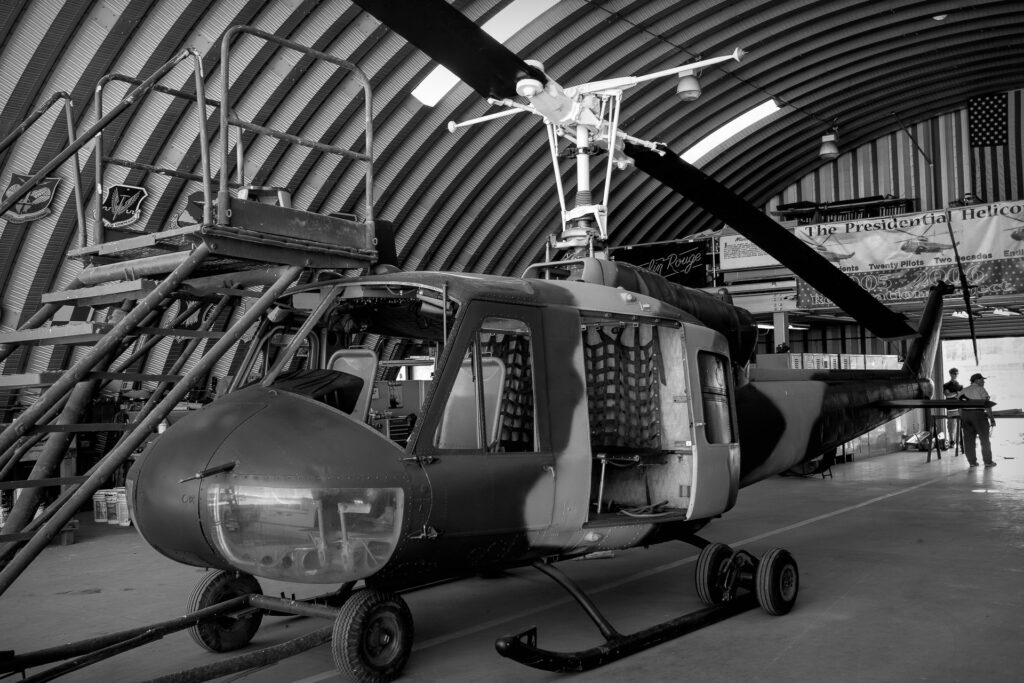
This Bell UH-1B Iroquois helicopter is being restored in the Dick Van Rennes Restoration Hangar at the March Field Air Museum in Riverside, CA.
The Bell UH-1B Iroquois, widely known as the “Huey,” became the defining icon of American air mobility during the early stages of the Vietnam War. Introduced into combat operations in the early 1960s, the helicopter transformed military tactics by enabling the rapid insertion and extraction of troops in the dense, inaccessible jungle terrain that characterized the conflict. These aircraft were highly versatile, serving as the backbone for the Army’s newly developed airmobile doctrine, which prioritized speed and flexibility over traditional ground transport. Beyond infantry movement, the UH-1B was adapted into a formidable gunship configuration, outfitted with door-mounted machine guns and rocket pods to provide essential close-air support for ground forces operating in high-risk zones.
The widespread deployment of the UH-1B significantly altered the battlefield landscape, forcing enemy forces to adapt to a war fought in three dimensions. Its presence allowed commanders to bypass conventional front lines, facilitating surprise maneuvers and providing life-saving medical evacuations that drastically improved the survival rates of wounded soldiers. Despite the challenges posed by extreme humidity, terrain, and increasingly sophisticated anti-aircraft fire, the Huey’s reliability and durability cemented its role as an indispensable asset. The aircraft’s ability to operate in small, unprepared landing zones effectively redefined tactical reach, ensuring that the Huey remained at the center of American logistical and combat strategies throughout the conflict’s escalation.