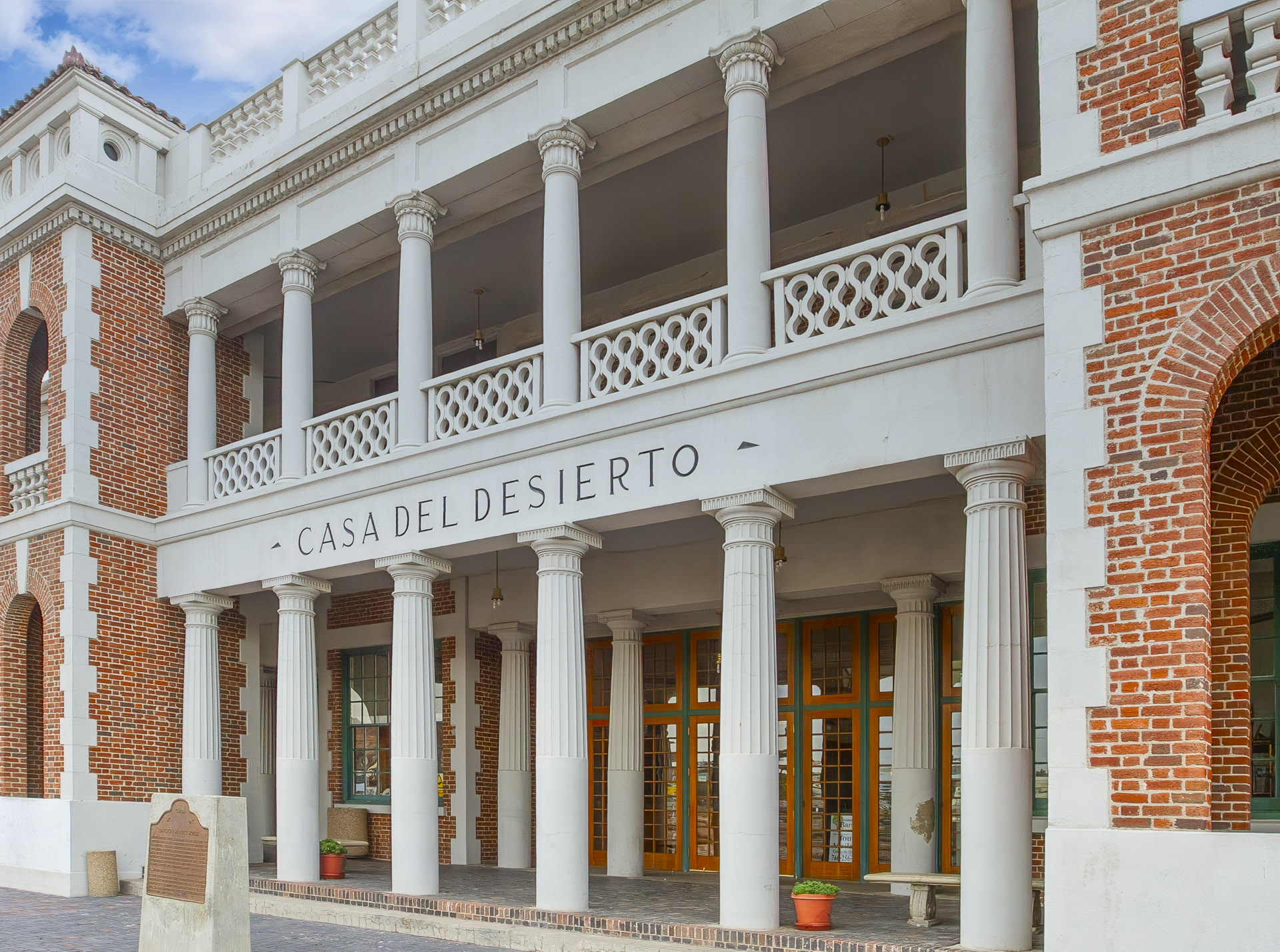
This is the Casa del Desierto, better known as the Barstow Harvey House, one of Barstow’s most important historic buildings. Its Spanish name means “House of the Desert.” It stands beside the railroad tracks and was built for the Atchison, Topeka and Santa Fe Railway as a combination railroad depot, hotel, restaurant, and rest stop for passengers crossing the Mojave Desert. The present brick building dates from about 1910–1913, replacing an earlier wooden Harvey House that burned in 1908.
The building was part of the famous Fred Harvey system of hotels and restaurants that served travelers along the Santa Fe Railway throughout the Southwest. Harvey Houses were known for unusually good food, clean accommodations, and attentive service at a time when long-distance railroad travel could otherwise be fairly rough. The women who worked in many of the restaurants became known as the “Harvey Girls.”
I think this photograph captures one of the building’s best visual contrasts—the bright white colonnade against the reddish brick. Architecturally, Casa del Desierto is especially striking because of the combination of red brick walls, white classical columns, deep shaded arcades, decorative railings, arches, and Southwestern/Spanish influences. Sources actually differ over the architect: the National Park Service attributes the present building to Mary Colter, while detailed City of Barstow material cites architect Francis W. Wilson based on Historic American Buildings Survey and contemporary accounts.
Passenger rail service declined after World War II, and Santa Fe eventually closed the station in 1973. The building deteriorated and was badly damaged during the 1992 Landers earthquake, including damage to its brick towers and second-floor walls. Barstow undertook a major restoration, preserving what had nearly become a lost piece of the city’s railroad history.
Today the restored building is still associated with rail travel and contains the Western America Railroad Museum and the Route 66 “Mother Road” Museum, along with offices and event spaces. It was placed on the National Register of Historic Places in 1975.
In the Mojave light, those deep porches were practical as well as decorative, providing shade from the intense desert sun. It is a building that reflects what Barstow once was: not merely a town beside the railroad, but an important stopping place between Southern California and the American Southwest.