
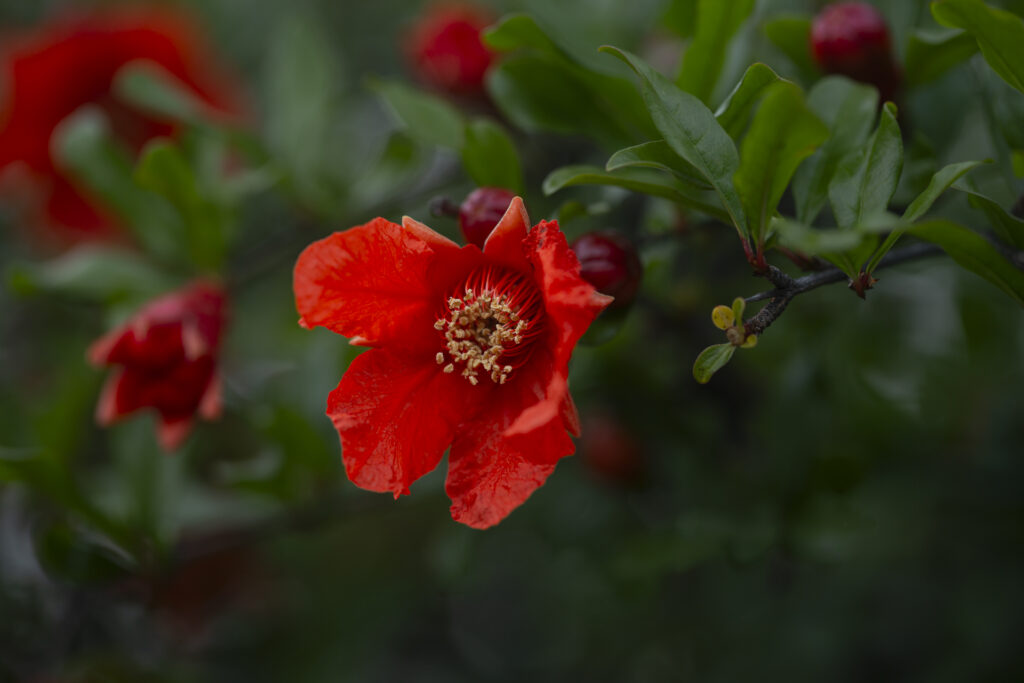
The pleasure of pomegranate blooms begins long before the fruit ever forms. It starts in that moment when the garden feels half-asleep, holding its breath, and then suddenly the shrub erupts with those improbable, flame‑colored blossoms. They don’t arrive politely. They flare. They insist on being seen. And somehow, every time, they feel like a small personal victory, as if the world has decided to hand you a secret celebration.
There’s a texture to the experience that’s hard to explain until you’ve stood close enough to notice how the petals look almost like crepe paper—delicate, crinkled, and yet stubbornly resilient. The blossoms sway with a kind of quiet confidence, as if they know they’re the most dramatic thing in the yard. Watching them, you start to understand why ancient writers treated the pomegranate as a symbol of abundance and desire. The blooms alone carry that energy. They feel like a promise whispered in color.
What I love most is how the blooms change the air around them. Bees arrive with a sense of purpose, tracing loops that seem choreographed. Sunlight catches on the glossy leaves, and suddenly the whole plant feels like a lantern. Even the ground beneath it seems warmer. It’s a reminder that beauty doesn’t have to be soft or pastel; sometimes it’s bold, unapologetic, and edged in fire. That boldness can be strangely grounding, a reminder that growth can be both fierce and elegant.
And then there’s the quiet pleasure of anticipation. You know these blossoms are the first chapter of a longer story, one that will eventually lead to the heavy, jeweled fruit. But in the moment, the blooms are enough. They’re a reason to pause, to breathe, to let yourself be surprised by something as simple as a shrub deciding it’s time to shine.