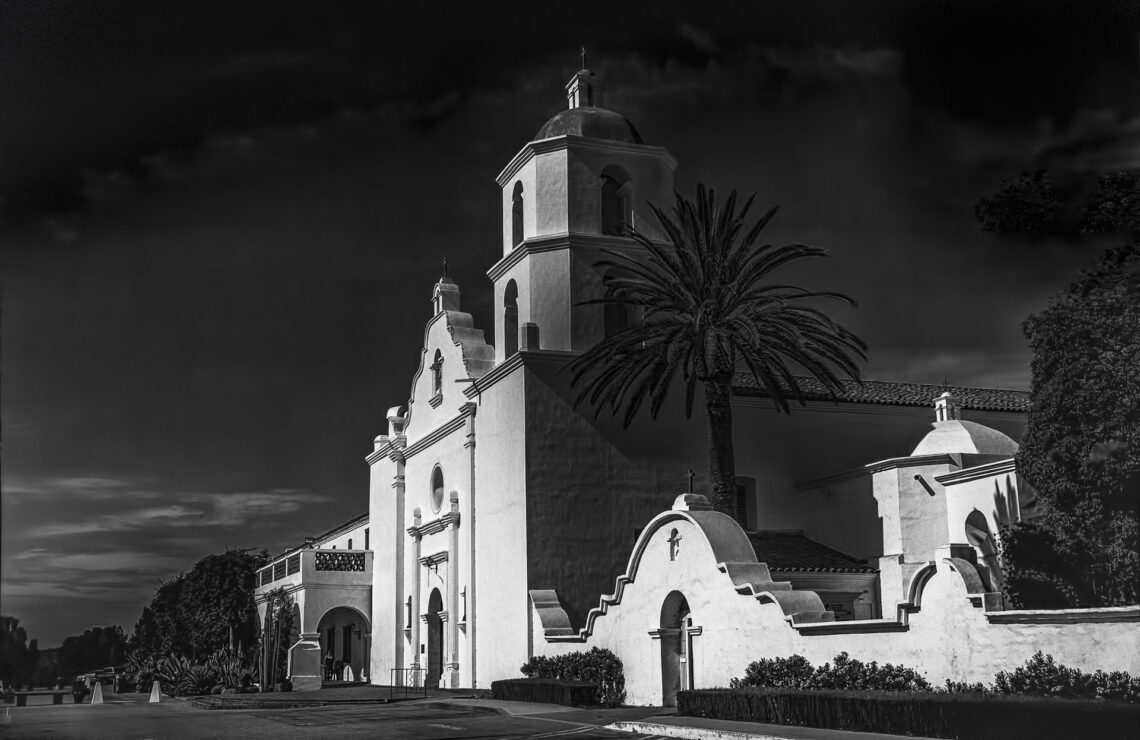
Founded in 1798 by Franciscan padre Fermin Lasuén on land long inhabited by Luiseño people, Mission San Luis Rey became one of Alta California’s largest and most prosperous missions. Designed in an expansive quadrangle with thick adobe walls and a broad central courtyard, its church and complex served as a religious, agricultural, and administrative center that oversaw vast lands and numerous native families. During the mission period the Franciscans introduced new crops, livestock, and European farming techniques, transforming the local economy while also imposing mission labor, religion, and social structures on the Luiseño community—changes that produced both material development and cultural disruption.
After secularization in the 1830s the mission’s lands were broken up and much of its wealth dispersed; the buildings fell into varied ownership and some deterioration until the Catholic Church regained stewardship in the 1860s. In the late 19th and early 20th centuries restoration efforts, archaeological work, and renewed religious activity revived the complex. The mission’s church, completed in its present form by mid-19th-century reconstruction, became noted for its stately façade, tiled roof, and richly carved altarpieces. Over time the site evolved into a parish church, a museum preserving mission-era artifacts and archives, and a cultural landmark interpreting both Franciscan and Luiseño histories.
Mission San Luis Rey’s historical significance rests on its role as a major colonial institution in Southern California, its architectural survival as one of the larger mission complexes, and its continuing place in regional memory—serving as a focal point for heritage tourism, education, and ongoing dialogues about colonial impact, Native American experience, and preservation. Today the site preserves mission-era buildings, religious art, and documentary collections that illuminate the intertwined stories of mission enterprise, indigenous resilience, and changing stewardship from the Spanish colonial period through Mexican secularization to American statehood and modern preservation efforts.

