
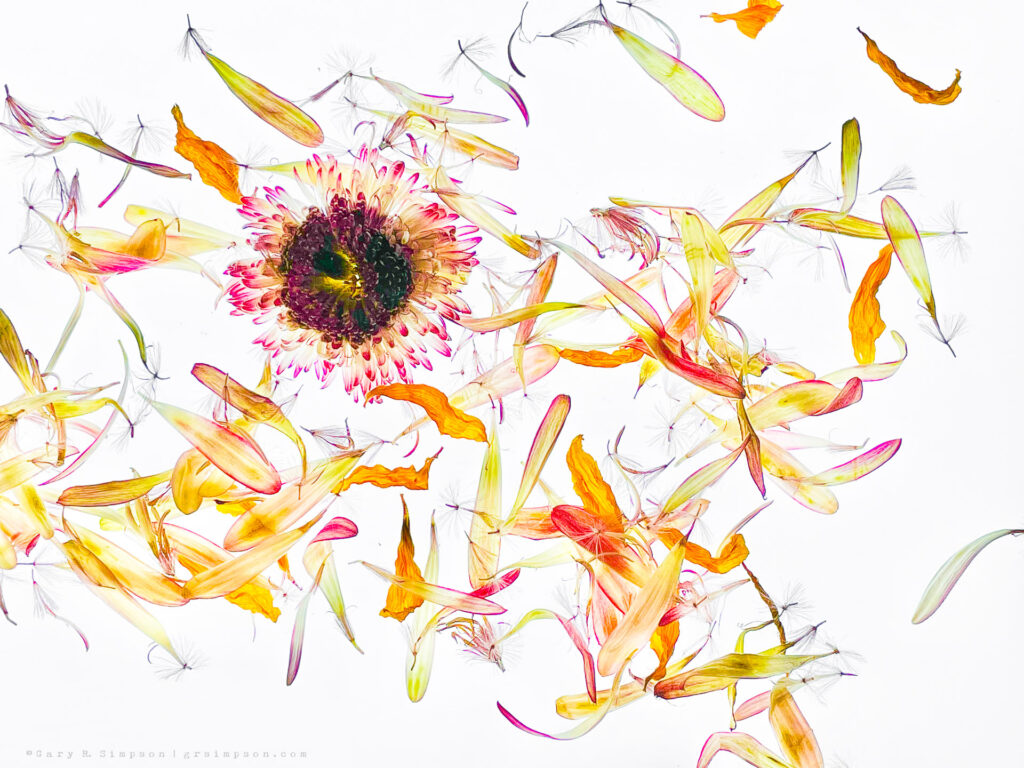
Flower photography on a light table creates glowing, translucent, x‑ray‑like images by illuminating the subject from below. It’s one of the most striking ways to turn simple flowers into fine‑art compositions.
Flower photography on a light table has a way of slowing the world down. You set a bloom on that glowing surface and suddenly the ordinary becomes delicate, almost otherworldly. The light rises through the petals instead of falling onto them, and the whole flower seems to breathe in a new direction. It’s a small reminder that changing your perspective—literally flipping the light source—can transform something familiar into something quietly surprising.
Working on a light table feels a bit like doing a gentle science experiment. You start noticing things you’d normally miss: the branching veins inside a tulip petal, the way a daisy’s center looks like a tiny architectural blueprint, the soft gradients that only appear when light passes through instead of across. Even wilted petals take on a kind of poetic transparency, as if they’re telling the last part of their story.
There’s also something meditative about arranging flowers flat on the surface. You’re not building a bouquet or chasing the perfect vase angle. You’re composing from above, letting shapes and colors fall into place like pieces of a puzzle. Sometimes the simplest arrangements—three petals, a stem, a leaf—end up feeling the most intentional.
The final images often look cleaner and more modern than traditional floral photography. High‑key backgrounds, glowing edges, and that soft, airy feeling make the photos feel almost like botanical illustrations. It’s a style that works whether you’re shooting with a DSLR or just your phone, and it invites a kind of playful experimentation that doesn’t require a studio or fancy gear.