
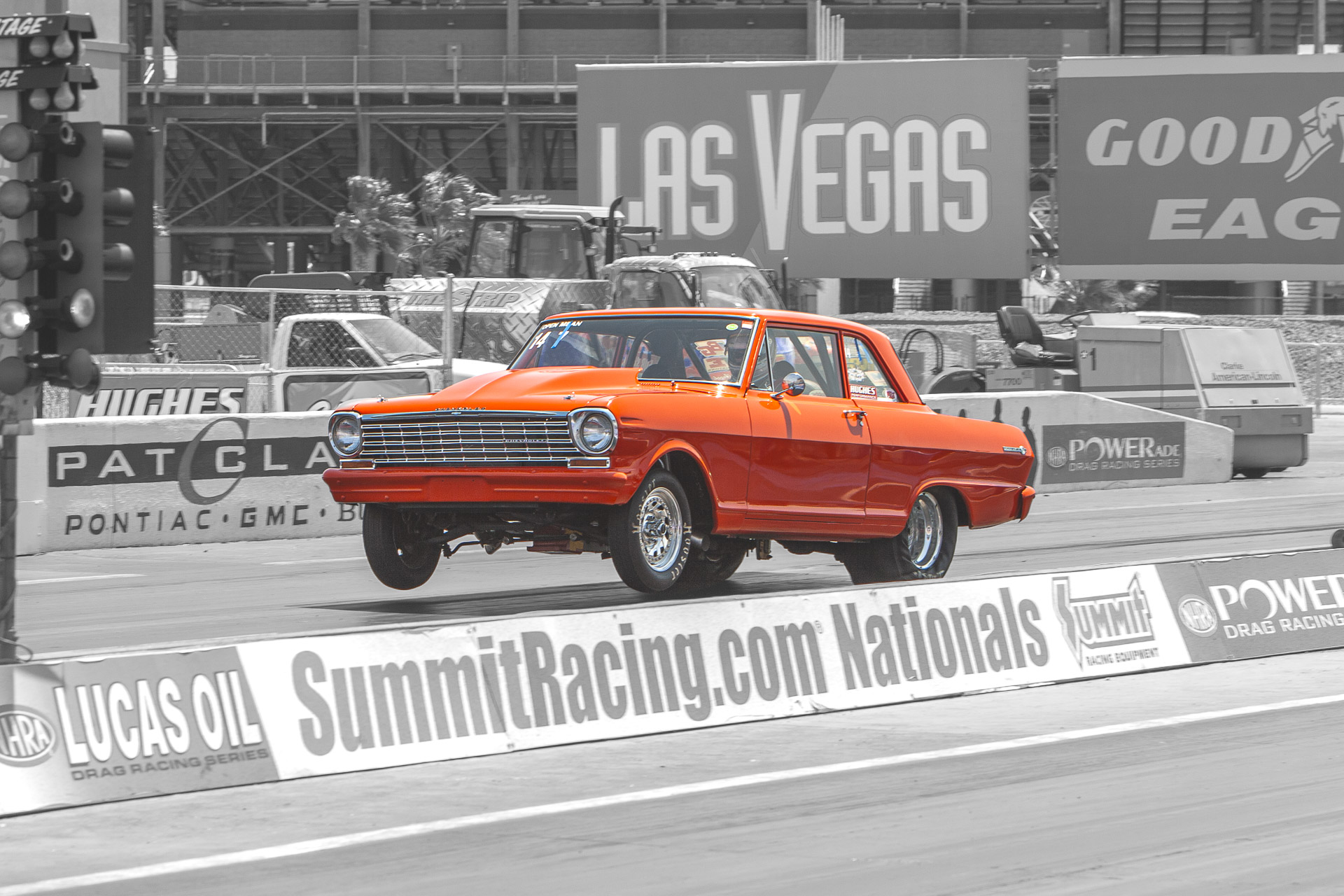
1964 Chevy II two-door sedan bracket racing in Las Vegas, Nevada, on The Strip at the Las Vegas Motor Speedway. The little Chevy II became a particularly popular drag-racing platform because its relatively compact, lightweight body could accommodate considerably more Chevrolet V-8 power than it originally left the factory with.
Building a Chevy II for Bracket Racing
Building a car like this Chevy II for bracket racing is a lot more involved than simply dropping in a big engine and bolting on a set of slicks. The whole car has to be built around one goal: doing the same thing over and over again. In bracket racing, outright speed matters less than consistency. A car that runs 11.02, 11.03 and 11.01 seconds can be far more competitive than a much faster car whose elapsed times are all over the place.
The engine is certainly important, but reliability and predictability are usually more valuable than squeezing out every last horsepower. A typical build might use a Chevrolet small-block or big-block V8 with an upgraded intake, carburetor or fuel system, performance camshaft, headers, stronger ignition and improved cooling. Behind it is usually a heavily reinforced automatic transmission, often with a racing torque converter, connected to a stronger driveshaft and rear axle. The gearing is chosen so the engine stays in its most useful RPM range while still producing repeatable launches.
The suspension receives just as much attention. At the rear, springs, shocks, traction devices and suspension geometry are adjusted to plant the slicks firmly against the pavement. Up front, racers often want the suspension to rise easily during acceleration, helping transfer weight toward the rear tires. That is exactly what is happening in this photograph: the Chevy II has transferred enough weight rearward that the front wheels have lifted completely off the track. It makes for a cool photograph, but for the racer the important part is whether the car launches exactly the same way on the next pass.
Then there is everything required to make the car safe. Depending on how fast it runs, that can include a roll bar or full roll cage, racing seat, multi-point harness, driveshaft loop, battery cutoff, transmission shield, fire-resistant equipment and other components required by the sanctioning organization. The brakes, steering, wheel studs, tires and fuel system also have to be capable of handling repeated hard launches and high-speed runs without becoming the weak link.
Once all of that hardware is installed, the real work begins: testing and tuning. Tire pressure, launch RPM, shift points, suspension settings, ignition timing and even engine temperature can affect elapsed time. Experienced bracket racers keep careful records because weather conditions such as temperature, humidity and air density can change how quickly the car runs. Eventually the driver develops a combination that behaves predictably enough to choose an accurate dial-in before each race.
That is what makes a bracket-racing car like this Chevy II interesting. It may look like a fairly simple old Chevrolet with an enormous engine, a pair of slicks, and a shiny paint job, but underneath is a carefully developed system in which the engine, transmission, suspension, tires and driver all have to work together. The wheelstand gets the attention, but repeatability is what wins the race.