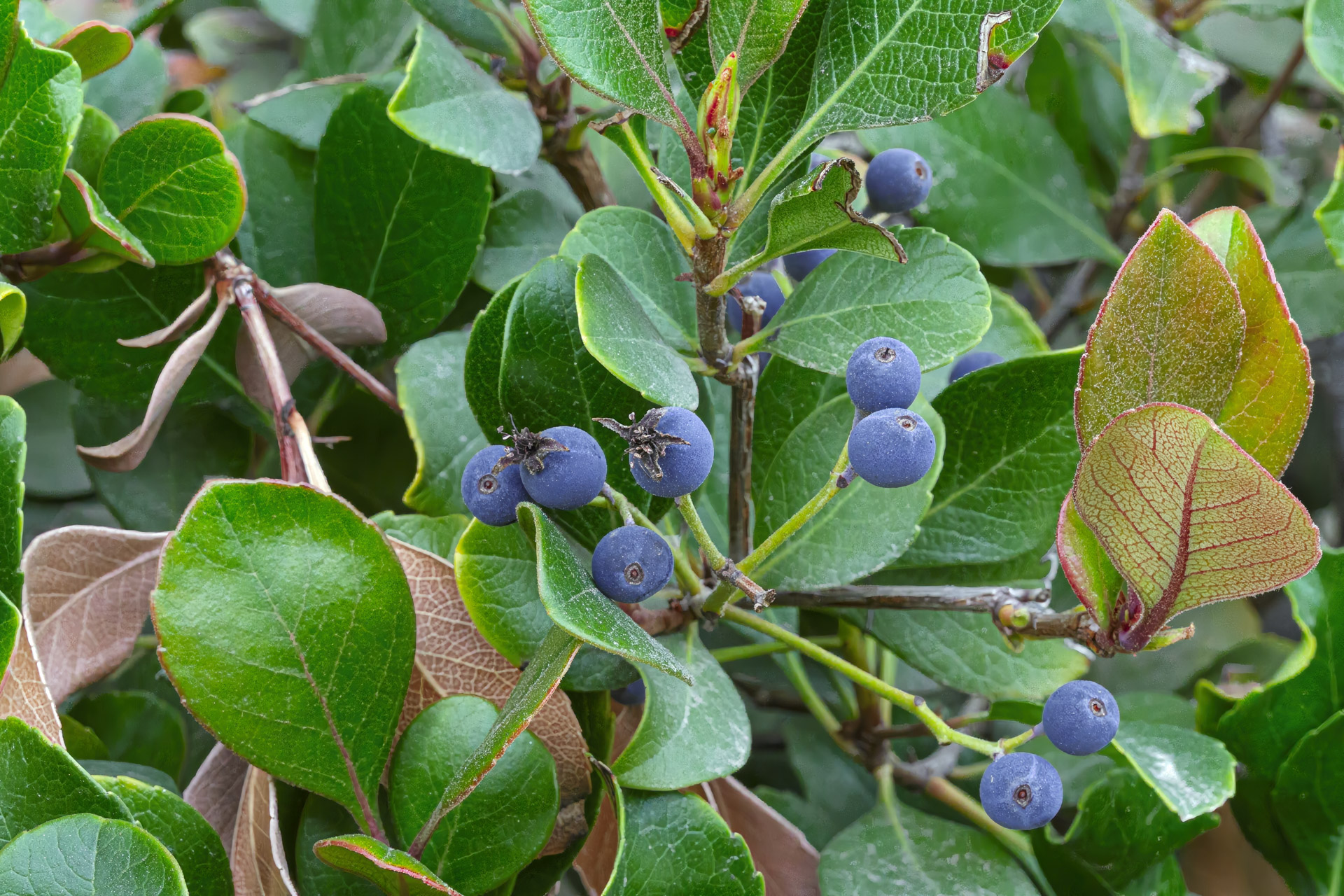
Indian hawthorn (Rhaphiolepis indica) is native primarily to southern China and Southeast Asia, with a native range that includes parts of China, Taiwan, Cambodia, Laos, Thailand, and Vietnam. Despite the name “Indian” hawthorn, it is not actually native to India.
It is best known for its clusters of pink or white spring flowers, but later in the year the shrub produces small, round fruits that ripen to a deep bluish-purple or nearly black. These little fruits often remain on the plant into winter, where they provide food for birds and other wildlife. Some Rhaphiolepis fruit is also described as edible when cooked, although Indian hawthorn is grown far more often as an ornamental shrub than as a food crop.
For such an easily overlooked part of the shrub, Indian hawthorn fruit has an important job. What begins as a showy spring flower eventually becomes winter food for birds—and, tucked inside every little dark fruit, a few seeds waiting for the opportunity to become another shrub.
As for the fruit, it is not generally considered poisonous. North Carolina State Extension notes that the commonly grown Indian hawthorn hybrid, Rhaphiolepis × delacourii, has fruit that is edible when cooked, and Plants For A Future lists R. indica fruit as edible with “no known hazards.”
One important caution: many landscape plants sold as “Indian hawthorn” are actually hybrids or cultivars, so I would positively identify the plant before eating the fruit. I also would not recommend eating the hard seeds. The fruit is much more commonly left for birds and wildlife than harvested as human food.