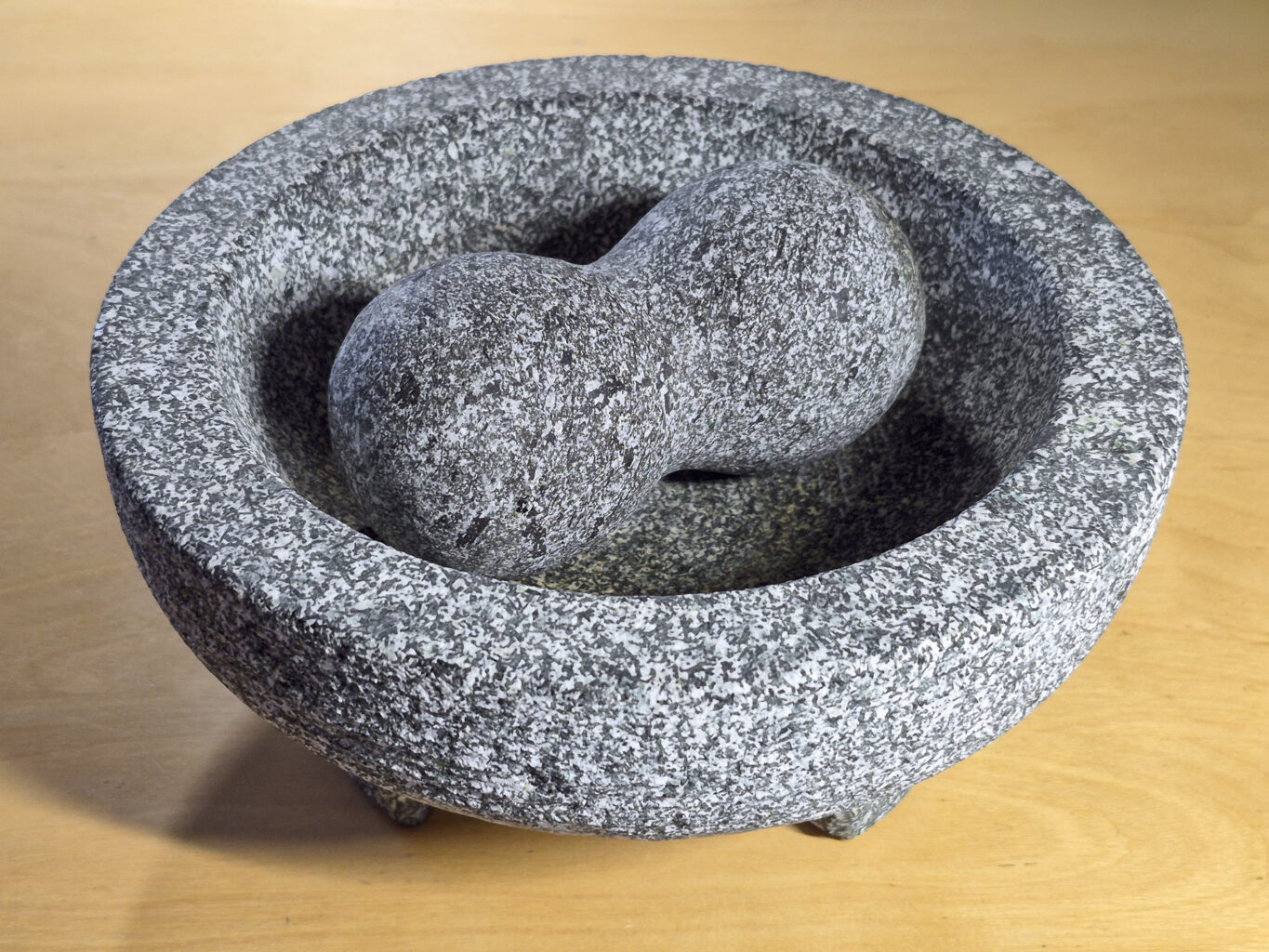
I have a perfectly respectable modern kitchen. I have electricity, a blender, a food processor and various other appliances designed to make food preparation faster, easier and considerably less physical. I can press a button and have something chopped, blended, pulverized or otherwise transformed into something edible. And yet I own a molcajete y tejolote. For anyone unfamiliar with the terminology, the molcajete is the traditional Mexican stone mortar and the tejolote is the stone pestle that goes with it. Mine is essentially a bowl and a club made from granite, an intrusive igneous rock formed from the slow cooling of magma deep within the Earth. Apparently, this is what passes for kitchen technology in my house.
The first thing you notice about a molcajete is that it isn’t particularly interested in being convenient. It is heavy. Not “a little heavier than a ceramic bowl” heavy. It is “why did I put this thing so far away from the counter?” heavy. You don’t casually move a molcajete around the kitchen. You make a decision to move it.
The other thing you notice is that using it requires actual physical effort. I can make salsa in a blender in about thirty seconds, while the molcajete requires me to grind the garlic, work in the chiles, crush the tomatoes and gradually combine everything myself. The blender would finish the job before I’ve developed a respectable rhythm with the tejolote. And yet there is something satisfying about doing it the old-fashioned way.
Part of that satisfaction comes from the texture. A blender has one basic philosophy: everything must become smaller. The molcajete takes a more nuanced approach. Some things get crushed, some get mashed and some remain recognizable. I can stop when the salsa looks and feels right instead of waiting for a machine to decide that I need something approaching the consistency of baby food. The same thing is true with guacamole. The avocado gets mashed while retaining some texture, while the garlic, chiles, onion or whatever else I’ve added remain part of the finished product rather than disappearing into a green paste.
Of course, there are times when I’m standing in the kitchen grinding something with the tejolote and wondering why I’m doing this to myself. The blender is sitting right there, completely willing to do the job without complaint. Convenience usually wins that argument, especially when I’m making a large quantity. But when I’m making a small batch of salsa, guacamole, garlic, herbs or spices, the molcajete often wins simply because the process is more enjoyable.
There is also something appealing about the object itself. A molcajete sitting on the counter has a certain presence. It looks useful, primitive and vaguely intimidating. It also looks considerably more interesting than a blender. I’ve always liked things that have a history—photography equipment, mechanical objects and traditional tools that don’t require electricity or a software update. There isn’t going to be a Molcajete Pro Max next year with artificial intelligence built into the tejolote. There isn’t even an owner’s manual. It’s a rock. You grind things with it. That’s pretty much the entire operating system.
There are disadvantages, of course. Cleaning it is more work than rinsing out a blender, a new molcajete needs to be properly prepared before use, and its weight means you don’t casually toss it into the sink. For large quantities, the blender will win the efficiency contest by a humiliating margin.
But efficiency isn’t always the reason I cook. Sometimes I cook because I want to make something, and sometimes I use the molcajete because I want to experience the process of making it. I don’t need a molcajete. I have other tools that can do most of the same jobs faster. But there is something satisfying about taking a few ingredients, putting them into a piece of granite and slowly turning them into something I want to eat. It makes cooking feel less like an assembly line and more like an activity.
So I’ve come to admit the obvious: I like my molcajete. I like its weight, its rough texture and the fact that it doesn’t plug in. Most of all, I like that every once in a while I can stand in my modern kitchen, surrounded by appliances designed to save me time, and deliberately choose the one that makes everything take longer. There may be no practical reason for me to do it, but practicality has never been the only reason to have a kitchen full of things.