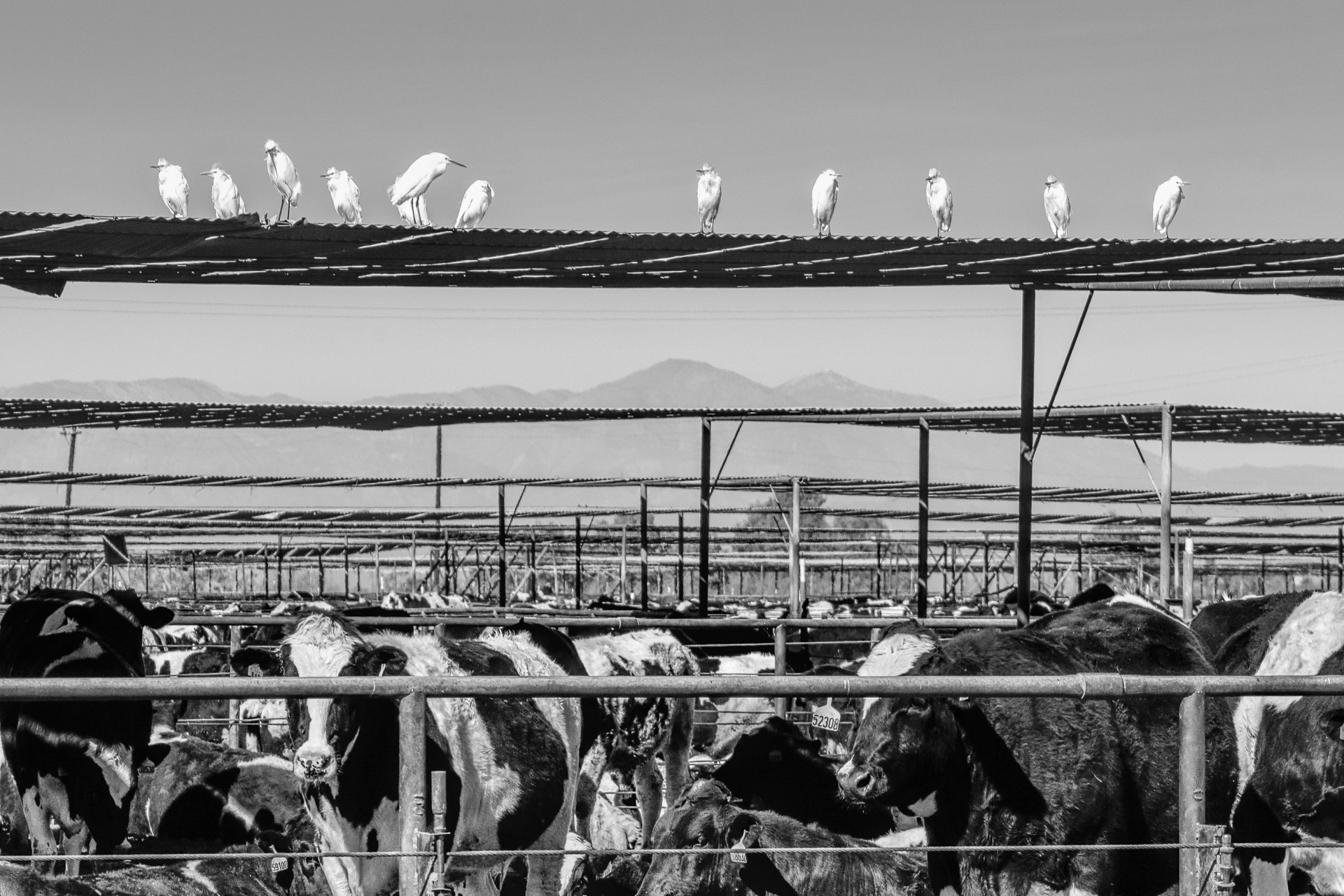
South of the Salton Sea near Calipatria, California, agriculture and desert wildlife often occupy the same landscape. Here, a row of egrets has claimed the roof of a cattle pen, quietly watching over the herd below while the distant mountains fade into the Imperial Valley haze. Egrets—particularly cattle egrets—are commonly attracted to livestock because cattle stir up grasshoppers, flies, and other insects as they move and feed, providing the birds with an easy meal. For the egrets, it is essentially dinner and a show. For the cattle, it is just another day of being followed around by white birds with excellent posture.
The orderly line of white birds above the crowded cattle creates an interesting contrast of shapes, textures, and tones, especially in black and white. It is a scene characteristic of this part of Southern California, where irrigated farmland, livestock operations, desert mountains, and birdlife come together in an unlikely but fascinating landscape.
The cattle are almost certainly feedlot cattle being raised for beef. Many of the black-and-white animals appear to be Holstein-type cattle, and Imperial Valley feedlots have a long history of raising Holstein steers originating from California dairy operations. Rather than being milk cows, male dairy calves can be raised specifically for beef, spending their final growing period in large feed yards such as those around Calipatria and Brawley.
At the feedlot, the cattle are fed a formulated ration—typically combining forage such as locally grown alfalfa with higher-energy feeds—to put on weight until they reach their target size for processing. Feedlot finishing is the last major stage before cattle enter the beef-processing system. At the time, National Beef operated a large beef-processing plant in Brawley, only a short distance from the Calipatria-area feedlots. The facility had capacity to process more than 400,000 cattle per year, and it specifically drew cattle from producers in California and Arizona. Beef processed there was distributed primarily into western U.S. markets, with some production also entering export markets.