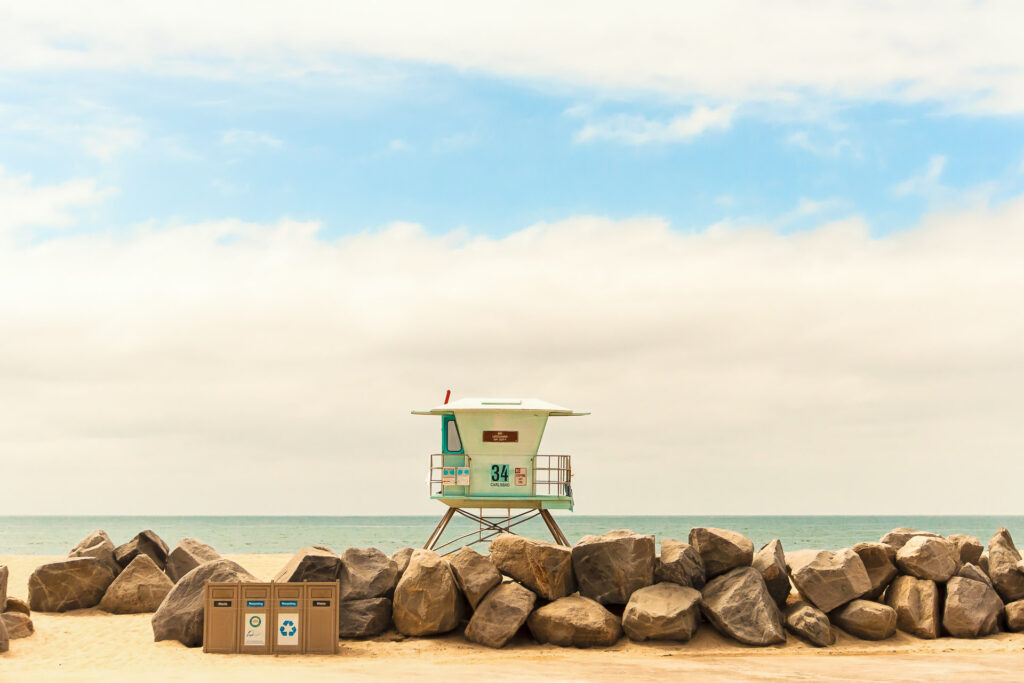
Walking along the stretch of sand between Carlsbad Village and the border with Oceanside, you start to notice a rhythm to the lifeguard stations. They aren’t dropped randomly on the beach; they’re placed with a kind of quiet logic that reflects how people actually use the shoreline. The city’s Marine Safety Division staffs four main towers from spring through October — at Army Navy Academy, Beech Street, Grand Avenue, and Oak Street — and these spots make sense once you spend time there. They’re the places where foot traffic naturally funnels toward the water, where families tend to set up umbrellas, and where swimmers drift into the surf.
Carlsbad’s northern beaches weren’t always guarded, and that history still shapes how the stations are arranged today. Before the city stepped in, the stretch from Oak Avenue up to Oceanside had no dedicated lifeguard presence because it wasn’t part of the State Parks system. Private property lines and the mean high tide boundary created a patchwork of responsibility, and as crowds grew, the city had to rethink how to protect people on that sand. When Carlsbad launched its own lifeguard program, the placement of towers became a balancing act between access, visibility, and the realities of a narrow, sometimes unpredictable shoreline that can shift depending on weather, surf, and sand movement.
What’s interesting is how fluid the setup can be. The official tower locations are the anchors, but they aren’t set in stone. Weather, surf conditions, and seasonal patterns can nudge the lifeguard team to shift their vantage points. On days when the sandbars change or rip currents carve new channels, the towers — and the lifeguards themselves — adapt. That flexibility is part of the culture here. Carlsbad’s coastline isn’t static, and neither is the way it’s watched over.
Even beyond the city-run towers, you can feel the layered approach to safety as you move south toward the state beaches. State Parks lifeguards take over at Carlsbad State Beach and South Carlsbad State Beach, where seasonal towers pop up above the bluffs and along the sand. Their placement follows the same logic: put trained eyes where the surf breaks hardest, where rip currents tend to form, and where visitors cluster without always realizing how quickly conditions can change.
All of this creates a kind of invisible safety net along the coast — a network of towers, trucks, and roaming lifeguards that shifts with the seasons and the tides. When you’re just strolling the beach, it feels effortless, but behind that ease is a lot of intentional planning. Carlsbad’s lifeguard stations sit exactly where they need to be: close enough to respond fast, high enough to see trouble forming, and spaced just right to cover a coastline that locals and visitors treat like a second home.
1 thought on “Lifeguard Station”