
(a work of fiction)
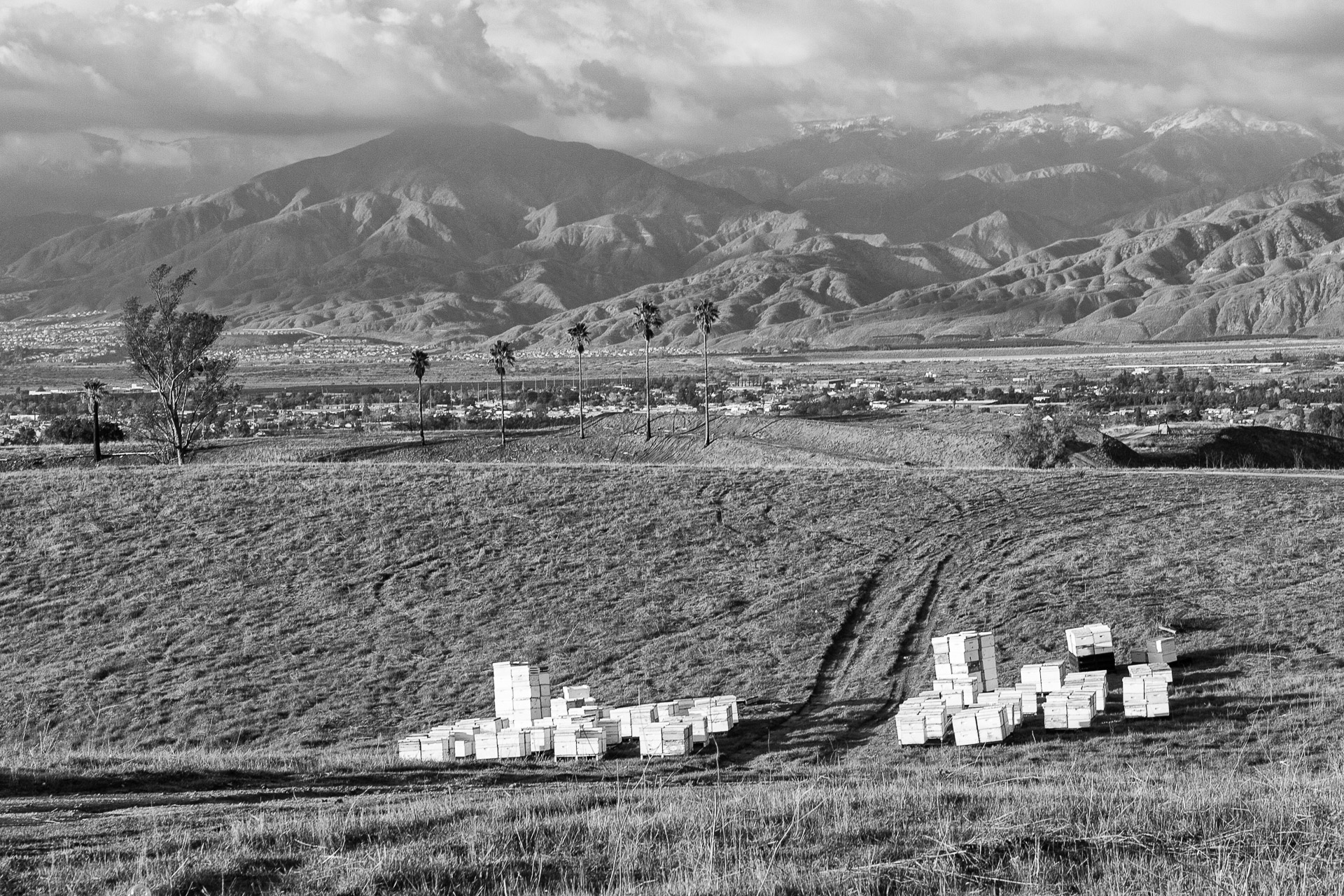
Before sunrise, when Yucaipa’s Crafton Hills are still blue with shadow and the San Bernardino Mountains are only beginning to catch the morning light, the beekeeper makes her way out to the rows of white boxes scattered across the hillside. She works alone, as she has for years, with only the steady hum of the colonies and the occasional sound of a truck on a distant Yucaipa road for company. Her first task is always the same: walk slowly among the hives, watching the entrances. A strong colony announces itself before she ever lifts the lid—bees streaming in and out, workers returning with their legs heavy with yellow and orange pollen. She checks the water barrels, replaces a cracked cover, and makes sure ants have not found their way into the weaker colonies.
As the morning warms, the beekeeper lights her smoker and begins opening the hives one at a time. She moves carefully, lifting each wooden frame into the sunlight and searching for the signs that tell her the colony is healthy: fresh eggs, young brood, stored pollen, and the glistening cells of new honey. She rarely sees the queen, but she knows when she has been there. During good years the bees range far beyond the hillside, working citrus blossoms in the valley and whatever is flowering among the chaparral—sage, buckwheat, mustard and countless small blooms that most people pass without noticing. Each season gives the honey a slightly different character, and the beekeeper claims she can tell what was blooming simply by tasting it.
By midday the hills grow warm and the bees become busier. The beekeeper retreats to the shade of her battered truck with a thermos of coffee and watches the colonies work. There is little hurry in beekeeping, she has learned. The bees have their own calendar, governed by flowers, rain, temperature and daylight rather than clocks. Some afternoons are spent repairing boxes and hammering new frames together; others are devoted to adding empty honey supers so crowded colonies have more room. During dry spells she worries about forage and water. After wet winters she watches the hills carefully, knowing that a few weeks of abundant bloom can fill a box with honey surprisingly quickly.
Honey harvest is the closest thing the beekeeper has to a busy season. She removes the heavy frames, brushes away the remaining bees and carries the boxes back to a small shed where the wax caps are sliced from the comb. The frames spin in an extractor until warm amber honey runs down the sides and collects at the bottom. She strains it but does little else. To her, the flavor belongs to the place—the orchards, the open fields, the chaparral and the changing seasons of Yucaipa.
Toward evening she returns the empty frames to the colonies. The mountains beyond Crafton Hills turn dark while the last sunlight falls across the valley, and the day’s traffic of bees gradually disappears into the boxes. The beekeeper stands for a while beside the hives before heading home. Tomorrow she will repeat many of the same chores, and the day after that as well. She does not mind the repetition. Out here, surrounded by thousands of bees yet working almost entirely alone, she has come to measure her life in quieter things: the weight of a honey frame, the smell of smoke and warm wax, the first citrus bloom of spring, and the low, constant hum rising from the hills.