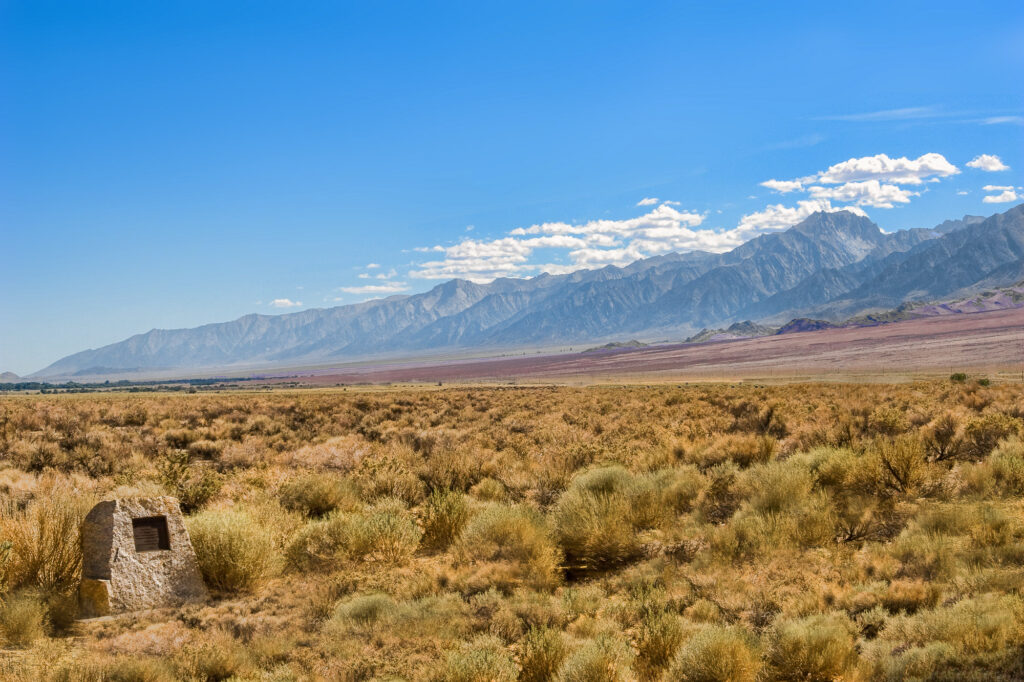
The view looking northeast across Owens Valley from Manzanar always feels like a quiet argument between memory and landscape. You stand there with the wind pushing at your shoulders, the highway humming in the background, and the Sierra Nevada rising behind you like a wall of stone certainty. But when you turn toward the northeast, the world opens instead of closes. The land stretches out in long, pale washes of desert, the kind of space that makes you feel both small and strangely unburdened. It’s impossible not to think about how different that openness must have felt to the people confined here, how the same horizon could look like freedom and impossibility at the same time.
From that angle, the Owens Valley feels almost gentle. The light hits the scrub in a way that softens it, and the Inyo Mountains in the distance look less severe than the granite giants to the west. There’s a kind of muted color palette—dusty blues, washed-out greens, the faintest gold—like the world is painted in past tense. Even the air seems to carry a slower rhythm.
What always gets me is how deceptively peaceful it is. You look northeast and see a landscape that seems to ask nothing of you. But the quiet is layered. It’s the kind of quiet that makes you think about the stories that unfolded here, the ones that don’t announce themselves but sit just beneath the surface. The view doesn’t dramatize anything. It doesn’t try to teach you. It just waits for you to notice.